
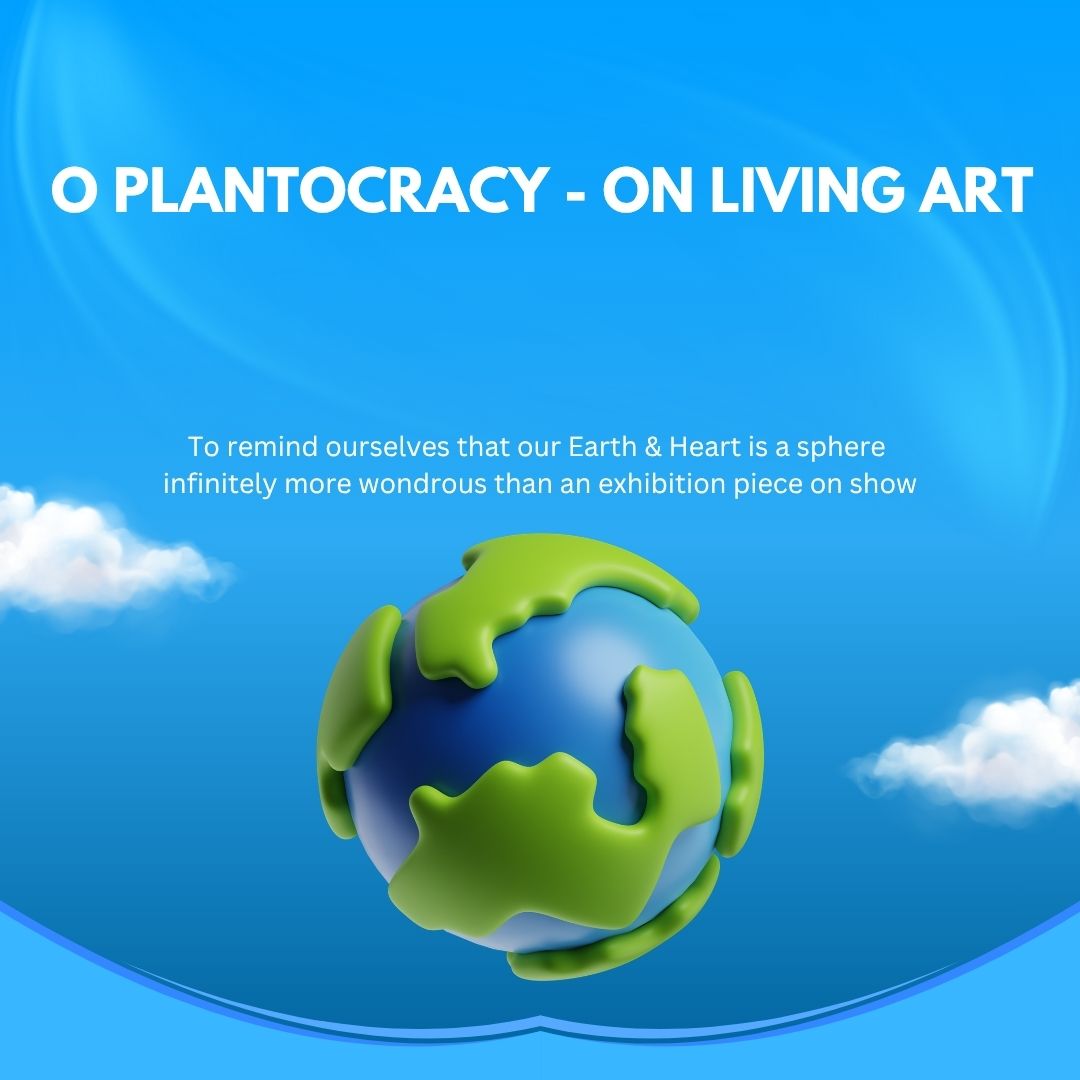
‘O Plantocracy’ – A Bioactive Terrarium, was one of several pieces of art that formed my exhibition, ‘Bound: Ligature & Graft’, commissioned for The Rum Story in Whitehaven, Cumbria. It is located in the courtyard of the heritage attraction, free to enjoy by anyone passing.
In 2025, The Rum Story was looking for artworks that: ‘demonstrated awareness of the historic context; would involve creative interventions where there are gaps in primary source material; take something inherently traumatic and find ways to subvert or reclaim it; and, help redress the balance and create visibility for people who were enslaved’. To my mind, a well made terrarium-art-concept could meet all these criteria. I was tackling the subject of rum’s history, not head-on, but sideways, and introducing perspectives of environment and ecology.
I was already immersed and a bit obsessed by the subject. Prompted by a poetry commission the year before by the Cultureword HardPressed Archive Project, my research connected the history of terrariums directly to maritime history and the cultural memory of Caribbean people in Britain. To write this now seems not at all surprising considering the far-reaching tentacles of colonialism. But my first encounter with this history – it completely rearranged the foundations of my thinking. I saw a glimpse of the global rearrangement of habitats that took place during the earliest eras of oceanic exploration and how the rise of economic botany created the link between plants and glass.
This made my proposal somewhat risky. Living plants as art raises valid questions about maintenance. Would there be care costs? What if it died? Nevertheless, I took confidence in my horticulture practice and was convinced that if it worked – this miniature, self-sufficient ecosystem – would stand as a victory on many counts.
The entire concept of ‘Bound: Ligatures & Graft’ centres plants as protagonists to the corresponding human narratives to those who lived under the shadow and gloom of enslavement. There are deep wounds, but how does art help us learn from the past, uplift us into beauty, resilience, regeneration and the continuation of life? My artwork recognises how betrayal to nature can also be considered a form of betrayal to humanity, whilst highlighting the shared responsibility of how to navigate times ahead. To heal the earth we inhabit now is perhaps more about our cultural and societal disposition – our hearts – than about eco-strategies, campaigns or science.
As part of my research, I travelled to Glasgow Botanic Gardens and spent a marvellous morning with curator, Dr. Hiro Shimai as he guided me through their greenhouses and private nurseries. He gave me cuttings of ferns, sugarcane, tea and coffee plants among others. This work of maintaining plants away from their native habitats speaks directly to the relationship between how the qualities of an environment can determine life itself. Reflecting on life in such terms is intriguing, and life’s intrigue leads me into art.
How did the observation of plants displayed under glass become so charming? The wealth and ability to travel that Britain gained in this period, created a fascination with the exotic and the luxury to develop the study of botanical sciences. Devised by London doctor, Nathaniel Bagshaw Ward (1791-1868) terrariums became a revolutionary step forward in preserving plant specimens aboard ships. His observations became the foundation for introducing plants into the British colonies, known as the Wardian Case, named after him. This new norm in plant transportation irrevocably altered global eco-systems but also sitting rooms and parlours of the higher social classes.
Gaining power exactly in this period was the plantocracy, which refers to a population of planters regarded as the dominant class, especially in the Caribbean. The earliest known use of the term is 1839, in Barbadian. It is a word so specific to this context, it originates precisely in colonial Caribbean, demonstrating the extractive and political beliefs of that period. One of the most challenging aspects of confronting the histories that shape us, is how to comprehend the atrocities that human beings commit to one another. This period of enslavement, endorsed by the plantocracy, is undoubtedly one of the darkest moments in the timeline of our species.
My display quotes Thomas Jefferson, “The greatest service which can be rendered any country is to add a useful plant to its culture.” He was a succesful Virginian plantation owner who enslaved his workforce. He was a member of the American plantocracy, and became the third US President. Maybe my childhood in the United States fueled my curiosity but I dedicated some of my research towards trying to trace a connection between President Thomas Jefferson, and the Jefferson family of Whitehaven. However, I couldn’t make any substantial link, and the Jefferson namesake is likely to be entirely coincidental.
The Jefferson family of Whitehaven, who had long-standing dealings in Virginia, even prior to their ownership of plantations in Antigua, perhaps reflects that there were a number of Jefferson families between Northwest England and colonial America. Nevertheless, I decided that the title, ‘O Plantocracy’ directs the viewer precisely to those historical attitudes, expressed clearly by Thomas Jefferson. And his quote felt a noteworthy inclusion that not only perfectly contextualised the artwork/terrarium.
The lush fertility of the earth’s tropical latitudes brought new and wonderous tastes to Europeans, but how did the human relationship to nature become so radically defined by commercialism, and further entrenched though colonial, agricultural and political systems? Consider that the earliest cuttings of sugarcane had been transported and transplanted by Christopher Columbus in the 15th century between the tropics of the Indian Ocean and Latin America. By the 19th century, curiousity and experimentation had become a brutally mechanised industry. Even terrariums would become essential for the successful movement of plants over long voyages.
During those centuries of exploration and exploitation, the global terrain seemed inexhaustible, and destruction may have appeared inconsequential, but we know now that was not the case at all. The Rum Story were inspired by my ideas and selected my proposal to make the environmental component to these histories more visible.
Today, which is internationally recognised as Earth Day, makes ‘O Plantocracy’ four months old. It hasn’t been watered since it was planted on 19.01.2026 (new waxing moon; biodynamic flower). One month ago, at the time of the Spring Equinox, the installation was also fitted with a growcam, its time-lapse feature was set for registering changes over time. This allows me to keep an eye at a distance and will allow the piece to be enjoyed more widely, digitally.
Here I have published images – both day and night, but a longer-term recording, at one time of day (rather than two) I hope will produce something more interesting to study and watch.
Peering into this orb offers a particular sensation as the various stages of self-regeneration are observed. How long might it survive, if each day the enclosure was disturbed; a plant was cut; or the bioactive insects were systematically extracted? To see the ecosystem in miniature, its fragility and also its potency, is somehow made more obvious. Without the regulation that plants provide, the water would become stagnant, the soil barren. Our biosphere is no different. Like most artists, I hope my work will provoke new questions. What if another kind of plantocracy was implemented? Where the rule of a healthy ecosystem of plants and trees became the dominant force on the planet… What kind of new life would be possible then?
Here are the flora and fauna contained in ‘O Plantocracy’: Leucobryum glaucum; Fittonia albivenis; Selaginella martensii jori; Elaphoglossum peltatum; Nephrolepis Exaltata; Nidularium schultesianum; Asparagus setaceus plumosus; Beneficial insect: Springtails.
Feel me (FM) on this subject? Continue reading the unabridged version on https:/frequencymonkey.substack.com/p/o-plantocracy.
Eileen Pun, 22/04/2026