

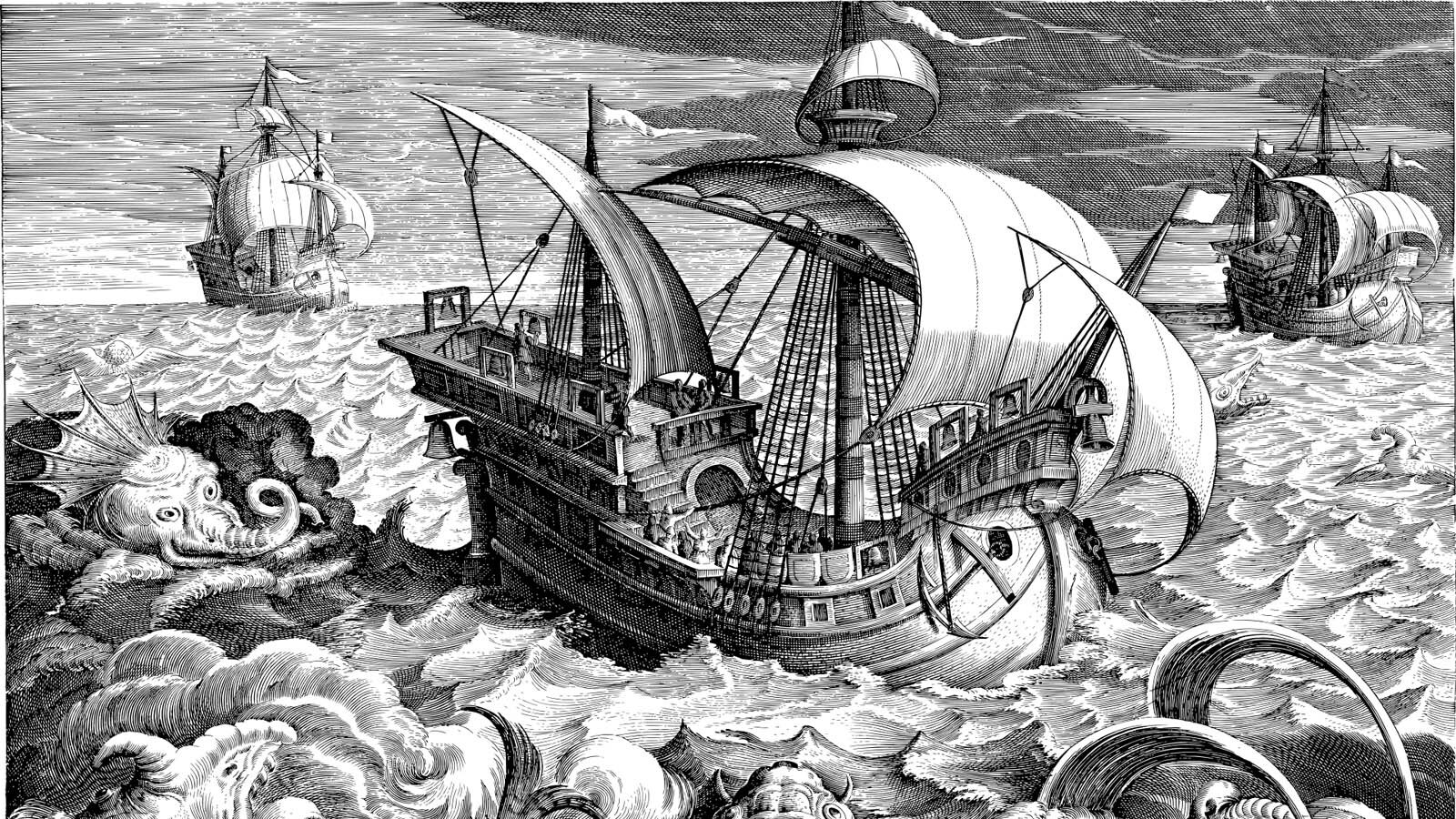
Tales of terrifying sea monsters lurking in our vast oceans have been passed down through generations. Seafarers would return from trips full of stories of their heroic defeat of such creatures. For those that didn’t return, it could be deduced that they’d met a terrible fate at the tentacles of such a sea beast. But how much of these legends were simply the ramblings of sailors that had too much rum? And how much could have been true?
Beware of the Kraken!
Imagine seeing a giant squid up close for the first time, having never even heard of such a creature before. According to the Smithsonian, they can grow up to 66 feet in length, and even now they are rarely spotted and remain somewhat of a mystery.
Explorers and historians spread the word of a squid-like creature though their books and drawings, instilling fear into sailors. 16th century Swedish explorer Olaus Magnus described the Kraken as a “monstrous fish”, with horns, red eyes and even a beard made of feathers.
Without the knowledge we have today, a giant squid could easily become a Kraken – one of the most revered marine monsters of all maritime history.
Later, in 1873, the first concrete evidence of the giant squid was found, when one was photographed and scientifically documented after attacking 2 fishing boats off the coast of Newfoundland in Canada.
While stories of the Kraken may have been subject to some “artistic licence”, their origins could be based on sightings of a creature that very much exists.
Sea Serpents and the dreaded Hydra
The giant squid isn’t the only mollusc that could be linked to maritime myth. Growing up to 30 feet across, the giant pacific octopus shares some similarities with both the Kraken and the Hydra, a creature which hails from Greek mythology.
Often depicted as having multiple heads on tentacle-like necks, the Hydra is famously able to regenerate two heads for every one decapitated, much like how an octopus can regrow lost limbs.
Another popular legend amongst sailors is that of the Sea Serpent. They were described as being up to 200 feet long, with a mane of hair and glowing eyes. While the length may have been grossly exaggerated, it’s very possible that they were encountering an Oarfish.
The longest fish ever discovered, the Oarfish can measure up to 56 feet, and the red spines on their head and dorsal fin running along their spine could be mistaken for a mane, especially in the darkness of a stormy sea.
From monsters to mermaids
Other legends are harder to explain. Like the Hydra, mermaids and sirens find their roots in ancient mythology. Sirens were originally depicted as large, ugly, bird-like creatures with the head of a women, who would lure sailors to their death with song.
In contrast, mermaids are usually shown as beautiful women with the tail of a fish. Throughout generations, the stories have become entwined and sirens are now often pictured similar to mermaids, but with monstrous faces.
In 1493, Christopher Columbus claimed he spotted three mermaids near the Dominican Republic. He described them as being “not as beautiful as they are painted, since in some ways they have a face like a man.”
Many scientists believe that people who claim to have seen a mermaid have in fact seen a manatee, though it’s hard to imagine how the two could be confused.
Tale or truth?
It is very plausible that early explorers met some as yet undiscovered species for the first time on their travels. Their very real encounters, retold back on land with some embellishment and exaggeration, contributed to the legends that have been passed down over centuries.
Now, with advances in science and ocean exploration, we can see how some these legends could have some truth to them, while others are a bit harder to comprehend.
Of course, there’s still a lot we don’t know about the world’s ocean. According to the US National Ocean Service more than 80% of the Earth’s water has yet to be explored, and new marine species are being discovered all the time.
With all that uncharted territory, the idea of monsters lurking in the deep isn’t completely beyond the realms of possibility.
Sources:
Five “Real” Sea Monsters Brought to Life | Smithsonian Magazine
The Sirens | Greek Gods & Goddesses
Ocean Exploration Facts | NOAA Office of Ocean Exploration and Research
Giant Squid | Canada’s History
5 Surprising Facts About the Oarfish | National Geographic