

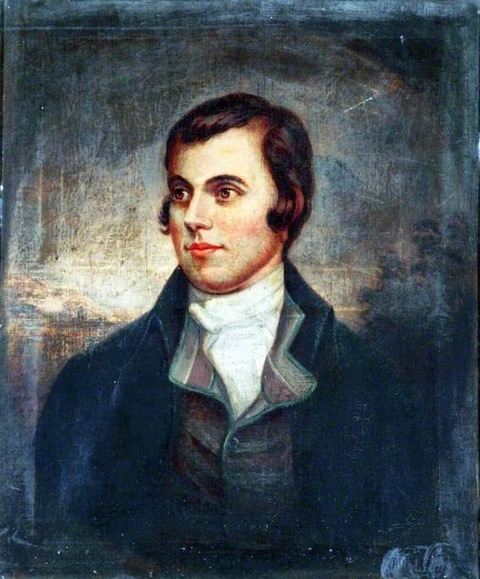
Robert Burns (1759–1796) was an excise gauger (tax collector), farmer and poet. He travelled the Solway coastal area as part of his duties; had dealings with customs/excise and coastal shipping and was involved in anti-smuggling activity in the Solway region. That means Burns’s world overlapped the same coastal shipping and commodity networks (tobacco, rum, sugar) that Whitehaven merchants used.
Whilst there are no direct links between the Jefferson family and Burns, as an excise officer his work was deeply entrenched in all aspects of transatlantic trade allowing regional, national, and international perspectives to inform his ideas, sensibilities and poetry.
His poem, ‘A Man’s a Man for a’ That’ written in 1795, this is one of Burns’s last works. It has become a firm favourite in Scotland, and was sung at the opening of the Scottish Parliament in 1999. The poem directly mentions enslavement, endorses equality in a nation, and rails against social injustices (cited National Trust for Scotland). To read the poem and learn more about his life, please follow the links below.
https://www.scottishpoetrylibrary.org.uk/poem/mans-man-0/
Through The Rum Story Re-Imagined project… poetry is one of the art forms in which we are exploring its history and cultural memories. This week, Eileen Pun leads an online creative writing workshop encouraging participants to consider the roots and seeds of enslavement from an environmental lens. We are very thankful to our local Whitehaven poets that have written compelling pieces in response to what they have experienced from the attraction.
Curious about an interesting fact? In Antigua, some traditional Christmas masquerades, such as “Highland Fling” dancers, wear kilts and perform traditional Scottish dances, showcasing cultural fusion blending African, European, and Caribbean cultural influences.
Image: Robert Burns – Image credit/ Atkinson Art Gallery Collection – Licensed Creative Commons (CC BY-NC-SA)